Sorry for the hiatus in wiritng on my blog. It's been almost two months since last time I have written. I will be adding more posts over the next few weeks to make up for the ones I have missed. I'm going to back date them because they are about things that happened over the last two months. I hope to catch up to the present time over the next two weeks. Thanks! Chris

Sunday, April 5, 2009

You're invited

  • more construction, finished 3.9 catchments, one more than last week
  • rain gauge placed at Lucas's home, 2.29 in on April 1st
  • rainwater catchment open house and children w+s training invitations sent out
So from an outsider's perspective, my construction seems to be taking up a lot of my time in these past three weeks. From my perspective, it definitely has.
(Note: Thanks to Jeff for recommending a bullet list on the top of my posts to give a quick summary (see CNN). Also, Jeff asked for a wider angle shot of the catchment which I've added on the right hand column and in my picture album. Keep the recommendations coming!)
Construction slowed down a bit this week but we still were able to finish off Pauline's catchment and get the gutters and foundation done at Christine's. We were planning to work on Maurice's gutters and foundation on Thursday and Friday. Sadly, Maurice's niece passed away so we moved the work at his home back to Monday. I don't know much about what happened but both Maurice and James, an agriculture leader like Lucas for w+s, were pretty torn up about it. Please keep their family in your thoughts or prayers.
We now have three fully completed catchments with a fourth, Christine's, being virtually finished. Marabe's and John's have both been done for quite a while and we have been getting good reports from both of them. Since finishing installation, neither of their families have had to collect water from the streams or springs. That's great news! Marabe's tank was completely full on Friday after rain on Thursday night.
The next big step is testing to see if the water from the catchments is potable. If they can drink straight from the tap, they will save the time and firewood required to boil the water for three minutes. Time is always nice to have more of and reducing firewood consumption will help deforestation which is a problem in Kuria, Kenya.
Lucas and I were able to set-up the rain gauge at his home in Nyametaburo, the village on the far eastern side of where we work. We tested measuring with water from my water bottle and then put the rain gauge up on a piece of wood out in the center of his compound. He has been taking data every day with our first rainfall recorded as 2.29 in on April 1st. Now we need just 364 more days and we'll have the data we need to do some better computer modeling for rainwater catchments!
The most exciting part for me this week was working with the leaders to invite w+s representatives to our upcoming rainwater catchment open house and children to the children w+s training. Lucas and I prepared invitations to both events in english and then translated them over to kiswahili. At our weekly leader meeting on Friday we passed out the 48 invitations to our leader to distribute to their w+s representatives. Below is the invitation to the rainwater catchment open house, click on it so see the english translation.
The rainwater catchment open house will allow the larger community to see some of the work we have been doing. The only people attending are the 48 w+s representatives but they will surely be telling their neighbors how the program is going. The open houses will be replacing our bi-weekly w+s representative meetings so the six leaders will be doing a bit more than just showing off their rainwater catchment. It will be a great exercise for the leaders to begin taking more responsibility in the w+s program. I'm very excited for the open house!
Training the people of Kuria, Kenya in proper w+s techniques is one of the most valuable things we can do in our program. Lucas has done a great job with training the adults in w+s techniques but we still need to reach the children. We have asked our leaders to train the children and many of them have but a few asked for some help. School has just finished and the children will be out until early May so we have decided to hold training sessions for the children in five different locations. The training will serve to train the children that haven't been and to see how well the w+s representatives have done with the children they did train. Here is the invitation we distributed on the back of the open house invitation. Again, click on the picture to go to an english version.
The open house is in two weeks and the children training in three so both are still quite a ways away. We will be working hard this week to finish most of the construction, prepare for the open house, and make sure that the permit application process is going smoothly for the wells we hope to drill soon.
five new pictures

Wednesday, April 1, 2009

Obosara, strong, and chai

Kenya, the Kuria area particularly, has quite a tradition in drinks.  When people have guests in their home, they always provide the guest with some sort of welcome drink.  It's a great tradition and I think we should export it.
These days, the drink you will most likely be served is chai, kiswahili for tea.  Chai is very much the same chai we drink in the states if you have ever been to a semi-fancy coffee house.  It consists of tea, milk, and a spice called masala.  The spice is my favorite part because it makes chai have a little kick.  Masala almost has a pepperish taste to it.  The drink is served hot and people always say that the hot chai cools you down by making you sweat.  I'm not sure that I believe that but I'll still drink it none the less.
An interesting side note about chai is that corrupt police and officials will sometimes ask for a bribe but instead of being direct, they will ask for chai.  The insinuation is that you'll pay for their chai but they just want some money out of you.  Thankfully, the officials and police we interact with are honest and take pride in their service for the community.  We've never had to serve up chai money.
Strong is probably my favorite drink so far.  Strong is essentially hot chocolate but it is much stronger than hot chocolate in the states.  It is also nearly all dark chocolate with little sugar so it tastes a lot richer, no where near as smooth as the hot chocolate I'm used to.  Strong is dark in color and made of only water and chocolate, no milk.  I still haven't figured out where the name strong came from but I'm working on it.
Obosara is by far the most interesting drink.  Obosara is the traditional drink of the Kuria people that used to be the only drink served to guests before chai and strong came in.  I've been privileged enough to have it twice now.  The drink is much like porridge but with a wicked twist.  Porridge by itself would be too boring so Kurians add yeast and let the porridge ferment for a while developing a sour taste.  When I first heard this I was kind of excited figuring it was a native alcoholic drink that I would get to try out.  However, when I asked Lucas if they fermented it enough to produce alcohol he did his now famous, "Ahhhhhhh no," and explained it was merely for flavor.  The taste is rather interesting to put it nicely.  I've always taken the first cup but never been thirsty enough for a second.  My Kurian friends always snicker at me when I drink it and more that emphatically offer seconds because they know obosara is rather strange to us westerners.  If nothing else, I think it's putting more hair on my chest.
The best part about all of these drinks is the custom of giving them to guests.  You know you are a welcomed guest when you have something warm in a mug.  It makes for a great time to chat and build relationships.

Sunday, March 29, 2009

2.9

This past week we finished 2.9 of the six rainwater catchments we're building for the pilot.  The 0.9 is for Pauline's whose gutters and foundation are finished but we are waiting for the foundation to cure so we can place the tank and put in the finished plumbing.
(Note:  I've put some more pictures up of the finished catchment at Marabe's home.  I'll also be making an addition to my posting schedule.  Every WEDNESDAY I will be writing a cultural post about Kuria, Kenya.  Many of you have asked for a better picture of what life is like here for both me and the locals.  I'll do my best to give you an idea by describing foods, customs, and even some language lessons.  Thanks for your feedback, it helps me improve my blog!)
The week began at Marabe's home putting his tank on the cured foundation and finishing off the piping into the tank from the gutters.  We skipped putting the cement on the pipe joints because I wanted to see how the system would perform before making it too permanent.  In the afternoon we headed to John's where we were hoping to quickly put up his gutters.  It wasn't as quick as we had hoped.
We had the good fortune at Marabe's home that his whole compound sloped where we put the gutters.  Because of the slope, we didn't have to worry too much about the slope of the gutters relative to the roof, we just made sure the rain would fall in from the roof.  The roof we placed the catchment on for John's roof was another story.  His catchment roof was at the top of his compound and the roof was essentially level to the ground.  It's great for construction but terrible for catchments.
The process for placing gutters is first nailing up the fascia board, then checking the slope of the roof, placing gutter clips, and sliding in the gutters.  Our estimation of the slope showed us that we could achieve the desired slope but the placement of the gutter clips is a little difficult.  The clips are exactly examples of precision manufacturing so there is some variation in their shape.  The fascia boards also rest against tree limbs so some of them curve more towards the ground than others, changing the gutter position even if the gutter clips are in the proper place.  So with these factors all combined, we ended up putting up gutters that flowed backwards in some parts causing pretty big leaks.  After some thinking and reanalyzing, we decided to slope the gutters towards the middle instead of one side.  This gave us more room for a steeper slope from side to side.  It took quite a while to put in the gutter clips, find out we messed up, pull out the clips, and then put them back in for our new configuration.  But we got it done at the end of the day and the gutters work great!
On Tuesday we put in the foundation at John's home.  Originally the plan was for the leaders to put the foundation in themselves but they got cold feet and we had the fundi help us out again.  The process was a little slower than Marabe's because some of the material was missing but John was able to pick it up in time for us to finish.  We put up the drain box and the piping to divert the rain from the foundation so it wouldn't be damaged if it rained.
Lucas and I also took a trip up to Migori to pick up the 4" plugs we will be installing on the first flush pipes so that the leaders can unscrew the pipes after the rain is over to flush out the dirty water in the pipe.  We also ordered six more drain boxes made by the local fundi but they weren't yet ready.
Wednesday we moved on to Pauline's to place the gutters.  It was quite a challenge because her roof beams where we were nailing the fascia were not lined up down the entire length of the roof.  But, the roof was sloped similar to Marabe's so we lucked out on having an easier time placing the gutters.  The plan was to do the gutters in the morning and the foundation in the afternoon but after finishing the gutters it didn't look like we would have time to do the base as well.  Also, since the leaders were going to try the foundation themselves this time I didn't want to rush them.
Thursday the leaders took a big step in constructing the foundation themselves with the fundi supervising.  Pauline's foundation went pretty smoothly although it was pretty obvious it wasn't a fundi job.  It's ok, the team is still learning.  The fundi stepped in at the end because the leaders were having a little trouble with plastering where you trow cement on the outside verticle surfaces to finish it off in a coat of weather proof cement.  There was a sense of pride in the air after finishing the foundation.  The team was really pumped.
Friday we headed back to John's to finish off the John's catchment with his now cured foundation much in the same way we finished Marabe's on Monday.  Afterward we had a meeting getting everyone's opinions on the progress and discussing how we can improve as we go forward.  It was also the first time the leaders found out about the plan to have an open house once all of the catchments are complete.  We will be having the leaders invite their w+s representatives, about ten each, to their homes to see what the catchments look like.  It'll be a great chance to get the word out to the larger community about the catchments as well as giving the leaders the opportunity to lead.
All in all a good week with some "office" work getting done on Saturday at home.  2.9 catchments down, 3.1 to go.
twelve new pictures

Sunday, March 22, 2009

Foreman

Construction has begun!  We've nearly finished the first of six rainwater catchments.  I've added a bunch of pictures of our two days of construction.
Our construction materials arrived on Monday from Migori, a semi-large town about 20 minutes north of Isibania.  All six of the 1000 L tanks plus the 3000 L tank for the Nuru house were crammed onto the bed of the lorry along with our 18 bags of cement, 100 2 m lengths of gutter, 7 20 ft pipes, and numerous gutter clips and pipe joints.  It was quite a sight to see!  The most absurd part was the drive from Isibania to Nymetaburo where we were storing the materials in the Nuru office at the dispensary (basically a health clinic).  The road from Migori to Isibania is a pretty decent paved road with the occasional pot hole.  Isibania to Nymetaburo is quite a different story, a single lane dirt road with tons of ruts and places where the road is washing away.  But, we made it!
The six team members were responsible to pick (Kenyan english for pickup) their tanks and three bags of cement each.  Some of the leader's homes are over 40 minutes away walking so it was quite a task but all of them got it done.  We could have hired a truck to drop off the materials but that would have been expensive and the trucks would have only been able to travel on the main roads, not directly to their homes.
Tuesday we did a lot of planning for the build and started to collect the final materials and tools as well as having our bi-weekly meeting with half of the w+s representatives in Sorrie Simba.  Lucas and I spent a few hours discussing the long term plans for our time together as well as setting up the meeting.  One of the key points we tried to get across in the meetings this week was having the w+s representatives train the children in their groups on proper sanitation techniques.  It's great that we've gotten the word out to adults about w+s but it is also immensely important to have children follow proper hygiene such as washing hands with soap and water and going to the bathroom in appropriate places, preferably latrines.
Wednesday morning was a little hectic with Lucas rolling in with tools in the morning.  There was a little miscommunication on Wednesday morning and some of the leaders went directly to Marabe's instead of the dispensary to pick the gutters, gutter clips, and other various things we needed for the project.  Thankfully, we had enough leaders to carry all the material down the long path to Marabe's in only one trip.  Lucas arrived shortly after with the tools and we surveyed the site and the materials.  Marabe and his family had done an excellent job of collecting sand, rocks, and water for the project.  Unfortunately, the rock pile Marabe had collected was right where we needed to place the tank.  We worked at a team to move all the rocks over about 6 ft to make way for the fancy new 1000 L tank.
In order to ensure that the tank was placed properly, the first thing that we worked on was the gutters.  By having the gutters in place we can more accurately place the tank near the end of the gutters.  We first measured the length of the roof and made sure we had enough fascia board and gutters to cover the length.    Then we went about hammering the fascia in place, then spacing gutter clips, finishing off with the gutters themselves.  The gutters had to be mated one inside of the other to prevent leaking so we had Christine and Pauline unbend one end of each gutter while they were still on the ground to better fit around the gutters in place.
The best part of the whole day was that I did very little.  Sure I showed Marabe, Lucas, John, Pauline, and Christine some tricks and how to keep things consistent.  But the majority of the work was done by them, exactly as it should be.  I am only going to be in Kuria, Kenya for six months, therefore it does nobody any good if I become an expert at rainwater catchment.  We need these six leaders and Lucas to take charges, as they did.  I was merely a foreman overseeing the operation and helping out when needed.
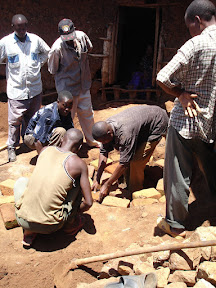
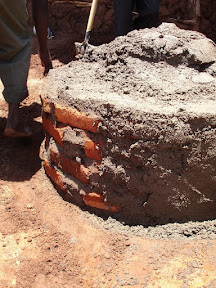
Thursday we completed the foundation that the tank will rest on inside of Marabe's compound.  By we I really mean the fundi (name for worker) completed the foundation.  Our team helped bring him the bricks and cement.  Because the gutters were already up, we simply placed the tank where we wanted it and traced it's outline to find where we wanted the foundation.  We dug down about 12 inches to provide a solid level surface to begin construction.  The  foundation consisted of two concentric circles of brick with and empty center.  The bricks were stacked six high with the last four layers above ground.  After finishing the last layer, we filled the center with big rocks and mud, capping it off with two layers of cement and bricks.  The entire structure was then coated in a final layer of weather resistant cement.  Because the bricks are made of sand, soil, and dung, they don't hold up well to weather if they are directly exposed to it.  The outer coating will lengthen the life of the foundation greatly.
The final task on Thursday was to whip up a piping scheme to keep the water falling out of the gutter from ruining the foundation as it cures.  It was one of my proudest moments in jerry rigging.  I'll have to take a picture of it, words just can't describe it.
Friday we met as a group at the dispensary and debriefed on the whole construction process.  The team came up with some excellent suggestions for how to proceed with the next five homes.  We also set up the schedule for the remaining homes and planned the next two weeks of construction.  I wanted to build alternating between women and men but John happens to live the closest to Marabe so our order is Marabe, John, Pauline, Christine, Maurice, and Elizabeth.  Everyone was really excited at the meeting.
Our original plan was to hire the fundi for the first two homes until we learned how to do the foundation ourselves.  All of the leaders knew this so they were watching the fundi intensely as he built Marabe's foundation.  At the meeting I was discussing how I thought the fundi had done a good job and was considering hiring him for at least the next foundation.  The meetings are run by Lucas in Kiswahili with occasional explanations to me in English after a discussion.  Following my suggestion about the fundi, there was 15 minutes of discussion between the entire team that was pretty intense.  At the end of the discussion, Lucas turned to me and said, "Chris, we want to build the next foundation ourselves."  Something inside of me skipped.  I was taken aback by the team's confidence and desire to build their own foundation.  I was incredibly proud of the ownership they were taking of the project from the hard work they were putting in to now wanting to build their own foundations.  
We discussed the idea a little bit and John said they only needed to know how close to put the bricks which they had watched carefully on Thursday, learning from the fundi.  The team also had such a desire because they know the long term plan is to roll the catchments out the community if we decide they are worth the expense.  The team wants to be prepared to help their neighbors.  This attitude is exactly why we selected these six, an innate leadership and desire to help the community.
So far one of my three big projects is off to a great start!  I look forward to putting the finishing touches on Marabe's rainwater catchment on Monday and starting John's, Pauline's, and Christine's next week!
nine new pictures

Sunday, March 15, 2009

Rainwater catchment

The transition of the water and sanitation (w+s) manager roll from Nicole to myself is almost complete.  This week I'm taking control of all the programs and Nicole is just going to be hanging around incase anything pops up.
The biggest project we are handing off is the rainwater catchment pilot project.  A rainwater catchment is a system of gutters and drainpipes connected to a collecting tank.  Rainwater is one of the cleanest water sources available and can reduce or eliminate the need for family members to collect water from springs and rivers many miles away.  If the system is properly maintained with roof and gutter cleanings, the homeowners may not have to boil the water to make it potable, saving the cost of firewood and the time required to heat the water.  Rainwater catchment is a very attractive solution to the lack of clean water available in Kuria, Kenya but there are many issues we have to resolve to ensure the usability of the system.  I'll run through our concerns and then describe our system.
The largest factor in the success of a rainwater catchment system is, as you probably guessed, rainwater.  Kuria, Kenya suffers from one long drought period from June to August as well as a few other dry months, February, November, and December.  These dry periods of very little and sporadic rain are a real challenge for designing rainwater catchment systems.  Buying or building tanks with large enough storage to make it through these droughts is cost prohibitive so sizing tanks becomes a game of balancing cost with usability.  If we spend too little and get a tank to small, the system may only be useful for 30% of the year, only on days that it rains making the system virtually useless.  If we spend too much and get a large tank, the farmers will not be able to afford buying the materials in the first place.  Unfortunately, we have very little information on rainfall patterns, we only have 24 months of total monthly rainfall data which doesn't give us the daily rainfall picture we need to make proper judgements.
The second factor is operation and maintenance.  The rainwater catchment itself is pretty simple but it requires quite a bit of effort from the homeowner to work properly.  If the homeowner neglects the system, the gutters and downspouts will get clogged, gutters will leak, and dirty water will make it into the tank.  Contamination can also come in the form of runoff from the homeowners courtyards as the courtyards are generally filled with animal excrement from corralling the animals at night for protection. Developing a rainwater catchment system with minimal maintenance and training the homeowners on how to perform the maintenance are two important things we must do to provide a sustainable solution.
Cost is the final factor for design.  We must reach a cost point that allows farmers to pay for the entire system without subsidies from Nuru.  Initially, Nuru will cover the full cost for the six w+s leaders and the 42 w+s representatives so that their systems can be models their neighbors can learn from.  When the program is rolled out to the larger community, Nuru may cost share the materials but we will eventually place the full cost of the system on the farmer.  By designing a system that the farmers can afford we will encourage the organic growth of the rainwater catchment adoption.  
Organic growth is a top priority at Nuru.  We will be leaving Kuria, Kenya within 5 years of arriving in September 2008 so if our programs are not designed to continue without our presence, they will fail.  We are here to give Kuria, Kenya a jump start and not fall in to the trap of dependance that has plagued other NGO's.  That is a big reason for community empowerment and why my Kenyan w+s counterpart Lucas has a much more important role in the community than I do.  I'm more of a behind the scenes advisor handling the technicalities and filling in where Lucas needs help.  One of those technicalities is the rainwater catchment system design.
I have been working with Nicole for the better part of two months hammering down a rainwater catchment design for Kuria, Kenya based on the typical local compound and material availability.
Our final design for the pilot consists of a 1000 L tank placed on top of a brick foundation with iron gutters flowing into a drain box which then flows into a first flush device and then the tank.  Most of the design is straightforward and easily understandable, all except the first flush device.  A first flush system is a device that collects the initial 1-2 mm of rainfall on the roof and diverts it from the main storage tank.  Maybe you're thinking why we would waste such a precious resource but if your consider the contaminate build up on the roofs and in the gutters between rainfall you would realize the need for a first flush device.  The initial rainfall collects all of the dirt, dust, and debris from the roof and gutters and is highly contaminated with everything from bugs to bird droppings.  By diverting it from the main storage tank we ensure the quality of the rainfall collected.  Amazingly, studies have been performed showing that this initial rainfall is the only portion of the water collected that is contaminated so once this rainfall is diverted, the remaining rainfall is almost perfectly clean.
Our first flush device is part of the drainage system from the gutters to the tank.  The gutters flow into a box we call the drain box that has a metal screen on the bottom to catch large debris from the roof.  This box connects to a PVC pipe that flows into the main storage tank.  Before the PVC pipe flows into the tank a T elbow splits the flow into our first flush device.  The PVC pipe flows roughly horizontal from the drain box and our T elbow sits just in front of the tank with the leg of the T facing down towards the ground.  To this, we attach another length of PVC pipe and cap the end which provides a known volume.  In order for rainfall to make it into the large storage tank, this length of PVC pipe will have to be full so that the rainfall will no longer flow down the leg of the T and will instead flow out of the other side of the cross of the T and into the main storage tank.  The known volume in the PVC pipe at the leg of the T will be calculated to capture the first 1-2 mm of rainfall and hence all of the contamination.  At the end of the rainfall, the homeowner will unscrew the cap of the first flush device and drain out all of the dirty water so that the system can function properly for the next rainfall.  This type of first flush device has been used widely in Thailand with great success and was featured in one of our design resources, Rainwater Catchment Systems for Domestic Supply: Design, Construction and Implementation by Erik Nissen-Petersen and John Gould.
The rest of the design is fairly simple, just gutters into a box and a big tank with a brass tap.  These first six rainwater catchments we will be installing are part of our pilot program to check if rainwater catchment systems are the way to go to provide safe drinking water for the community.  We will be testing out all of our concerns and collecting all sorts of data including highly accurate daily rainfall data from a USGS rain gauge so that we can correlate tank volumes with rainfall data.  Best case we find our system works well and it is usable for the majority of the year.  Worst case we find out that rainwater catchments are too expensive for the use they provide.  The middle of the road and most likely case is that we will have to improve our system but have found that in general it is very useful to the homeowners.
This week we will be getting the materials we purchased last week and will begin construction of our first rainwater catchment system on the home of one of our leaders, Marabe.  The six leaders will come to assist with construction and help us adjust the system as we are installing it.  We will then move on to the next five homes and hopefully finish all six within three weeks. There will then be a long period of data collection so that we can evaluate the systems.  After crunching our data and redesigning we will implement our new and improved design on the original 42 w+s representatives plus about 50 new representatives from a second recruitment drive.  We are shooting for early 2010.
After we have 100+ examples in the community we will move to the more organic phase of the program where farmers will take out loans to install the rainwater catchments on their homes, paying them back after harvests.  We have established a Community Development Committee (CDC) in Kuria, Kenya that will continue all Nuru programs upon our departure.  Lucas, my w+s counterpart is one of the members of the CDC and is moving toward the independence and responsibility that will be required of him when Nuru moves out of Kuria, Kenya in just over four years.  We have been working on other revenue generating programs for the CDC such as the farm loans in order to ensure it's sustainability without western funding.  Nuru will maintain a connection with the CDC in Kuria, Kenya but we will only be checking in.  When we leave, Nuru is the community.
As a final thought I would just like to bring up one of the largest reasons we are so concerned with bringing clean water to the families of our community.  The vast majority of people collecting water for families are school age girls.  Their water collection duties are difficult and in some cases make going to school regularly impossible.  This is especially true when they have to hike and queue for hours during droughts because most of the nearby springs dry up forcing the community to migrate to the deeper springs.  Obviously this cripples the education of these young woman and thereby their empowerment.
Kuria, Kenya is a patriarchal community but many powerful women are becoming leaders in the community.  It has been shown that the number one most important factor to making communities grow and bringing them out of poverty is the empowerment of women.  It is an issue we as westerners cannot take on head first because we will be looked upon as forcing western ideas on people we don't fully understand.  But, we can give girls and young women every opportunity to empower themselves with programs such as the rainwater catchment that eliminates the need for them to work hours everyday just to provide clean water for their families.
Even from my personal experience of being surrounded by strong women, my mother especially, I know how much of an impact they can have on a family and community.  Women have a way of fighting tooth and nail for their children so that even if they are dealt a raw hand, they can still prosper.  Empowered women fighting on behalf of their children and community are a force of nature to be reckoned with.
twenty-two new pictures